Houston's weather last year was largely tranquil, with one 'hidden' exception

Originally published at: Houston’s weather last year was largely tranquil, with one ‘hidden’ exception – Space City Weather

In brief: In today’s post we take a look back at the year in weather for 2025, which had few major stories. The notable exception was a winter storm back in January. There was also a hidden, but significant story as well. We also take a look ahead to a stand-out weekend and warmer weather for much of next week.

A look back at 2025

In some ways, last year was one of the quietest in recent history weather-wise for Houston. The most notable event occurred in January, with a hard freeze and widespread snowfall. Do you remember the snow? Many locations picked up 3 to 5 inches, and following this low temperatures dropped into the upper teens.
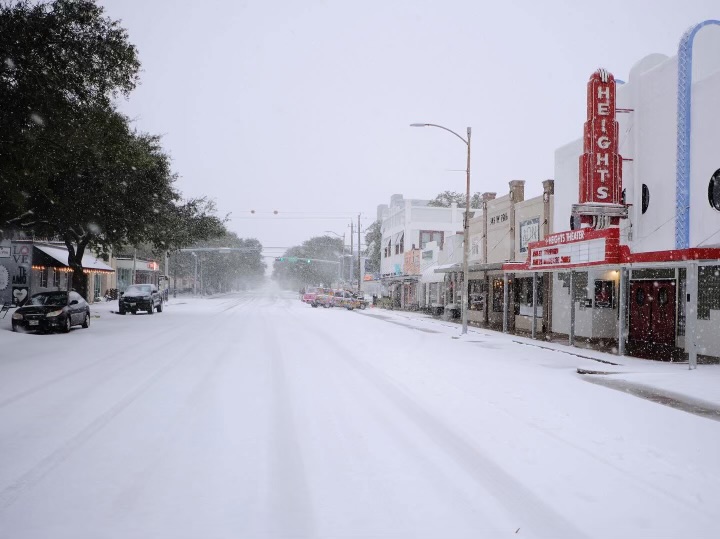
But after this January winter storm Houston’s weather turned tranquil. We made it through spring without major, widespread storms or flooding. All summer we experienced nary a tropical storm in the Gulf. Laughably, the only “threat” was conjured up on social media in July, when some non-meteorologists were energetically warning Houston that a hurricane was on the way. (It was not). Fall came and went with mostly calm weather as well, aside from a few tornadoes. Winter, to date, has been fairly mild. When you add it all up, it was a quiet year, especially after January. We see that in our website traffic. We average about 10 million page views a year on Space City Weather, and we were down by about 30 percent this year. I’m not complaining, I don’t like scary weather that threatens my home and family, either.

In one way, however, the weather in 2025 was extreme.

I am speaking about temperatures. I went ahead and plotted the average annual temperature in Houston dating back to 1969, when the official monitoring station was first moved to Bush Intercontinental Airport. It turns out this year’s average temperature of 73.0 degrees was the second hottest in the nearly six decades of records there. It was exceeded only by the mark of 73.1 degrees in 2024. In fact, the last three years have recorded the three hottest annual average temperatures at the airport since its opening in 1969.

One of the things that stands out on this graphic is that the annual average temperature in the 1970s was nearly five degrees lower. Now global temperatures have not risen that quickly, and it is not possible to say how much of the warming observed at Bush airport is due to climate change. Some is very likely due to urbanization around the airport. But a significant chunk is clearly due to a warming planet, as similar trends have occurred elsewhere, including Galveston Island. There is no question that Houston is quite a bit hotter now than it was half a century ago. Even a decade ago, for that matter. That is the hidden extreme from last year.

Friday

Speaking of heat, today will bring it. Highs will crest in the low 80s, maybe even mid-80s for some locations, thanks to a warm southerly flow ahead of our next front. Winds will be gusty, from the south up to 25 mph. The record high temperature for today is 81 degrees, and I’m fairly confident we’ll strike above that comfortably. In any case, we will be about 20 degrees warmer today than is customary for early January. The warmth will be goosed by mostly sunny skies. Lows tonight will only drop to about 60 degrees, before cooler and drier air arrives on Saturday morning.

Saturday and Sunday

The weekend won’t feel much like January typically feels in Houston, but it’s going to be gorgeous all the same. We should have wall-to-wall sunshine, and lower humidity. Saturday morning will be a bit windy, with northerly winds up to about 20 mph. But they should back down during the afternoon. Highs on Saturday will be in the upper 70s, with lows on Saturday night dropping to around 50 degrees. Sunday will be splendid and sunny, with highs around 70 degrees. We’ll have another night with lows around 50 degrees on Sunday night.

Next week

Much of next week looks warm for January as a ridge high pressure builds over the central United States. Monday probably will not reach the 80s, but most of the rest of the week will be in the vicinity. Skies will be mostly sunny during the daytime, and with dewpoints in the low 60s it will feel moderately humid. Nights will be mild. At some point a stronger front will push into the region later next week, probably late on Friday or Saturday. I don’t have much confidence yet in the details, but there could be a modest splash of rain with the front, perhaps on the order of one-half inch. For many parts of Houston there has not been significant rain in nearly four weeks, so anything would be welcome.

As for my runners, let’s hope that front makes it in time for the Houston Marathon on Sunday. I’m about 75 percent confident that it will, and we’ll have start-line temperatures in the upper 40s to lower 50s, with drier air. But there are risks. One is that the front is delayed, in which case we’ll be quite a bit warmer and muggier. Another is that the front comes through just before the run, and we see some lingering showers. Overall, I’m hopeful about race-day conditions, but not confident yet.

Have a wonderful weekend, everyone. I’m going to be outside a lot, soaking in this great weather.

3 Likes

I remember the snow last January! I have photos from walking around the park, and I like to look at them sometimes to remember how special it felt.

I’m curious how rising temperatures will affect my life in Houston.

  • Obviously I’ll use more electricity for HVAC.
  • I expect stretches of winter to be significantly warmer (like 2025). This means it will feel great being outside in the winter time.
  • The plants I grow in my garden will change to accommodate different temperature and sun stress. This year I’ve noticed some plants staying alive much longer than they have in the past, and even some caterpillars are still living which I haven’t noticed in previous years.
  • Being outside in the summer will be less comfortable (meaning it gets hotter earlier in the year and stays hot for later in the year). During my summer morning runs I’ve noticed that night time low temperatures are ~4 degrees hotter than 10 years ago.

Finally, please keep up the marathon weather predictions! It is my first time running a marathon and I’m excited to see how the weather turns out.

2 Likes

Thanks to a hot first week of February, and a a very warm Spring and Fall, we had the record highest number of 80s in 2025 surpassing 2024 and it wasn’t even close.

1 Like

with the temperatures getting warmer, it seems like in the long run, the best places to be if you want nice weather will be probably between the texas panhandle and south of wisconsin? I am sure they wouldnt mind warmer winters.

The near record warm falls of 2024 and 2025 definitely helped boost that annual mean I’m quite sure. I’ve been saying for a while now that I believe that the effects of a warming world is what’s causing us to get so warm in between the cold fronts during the winter. The tropics and ocean temperatures overall must be warmer than they used to be on average. So, when cold fronts retreat and winds turn back out of the southeast and southwest, we have warmer and more muggy air washing back over than we did just a decade ago.

The duration of these winter warm ups seem to be lasting alot longer than they used to as well. I know some of that can still be linked to natural variability like the ENSO and Arctic Oscillation, but climate scientists are pretty confident at this point that the effects of climate change are directly affecting jet stream patterns around the globe overall. The average position of the jet stream winds have been gradually shifting poleward over the past few decades, which is why our winters seem to be getting shorter and our summers are starting earlier and lasting longer.

This is also causing us to be repeatedly stuck in these blocking upper level ridges of high pressure, resulting in long periods of warm and dry weather during the fall and winter. The poles are also warming much quicker than the rest of the globe, which is reducing the sharp temperature contrasts around the globe. This is weakening the jet stream winds overall, which is also leading to more blocking patterns like heatwaves, which are occurring more frequently and lasting longer than before. On the flip side it can cause other regions to be stuck under low pressure systems longer, resulting in more rain and flooding issues.

If I’m not mistaken, I think longterm jet stream studies have shown that these “blocking” patterns are occurring three times as frequently now than they did since the 1950s. So, unfortunately the evidence continues to be overwhelming that we are in a steady upward trend in temperatures and extreme weather overall and nothing is going to change unless we stop adding more to Earth’s natural greenhouse ASAP.

1 Like

Just for fun I looked up the number of days that have reached 80 degrees in December at the Palacios airport.

Between 1943-1980 there were 22 80+ degree days in December.

Between 1981 and 2019 there were 40.

Since 2020 there has already been 19 days at or above 80 in December for Palacios in just a 5 year period. Let that sink in. There is no urban heat island effect at the Palacios airport either.

1 Like

Starting to look forward to summer again just because in winter it gets very very dry in my house :confused:

I feel like the March derecho was due a call-out when talking about extreme weather. (I lost a tree, had a $10K bill, and still have a fence that needs replacing).

1 Like

I’m concerned with getting too comfortable and BAM hard pipe bursting Freeze in Feb or early March.

1 Like

Something not fun about December is that every December this decade besides 2020 (which was bullseye on the normal) was above average. We haven’t had a December below average 2017, which was funnily the warmest year at the time. Before it was broken in 2023. Before that was broken in 2024. It’s a byproduct of the Gulf of Mexico getting warmer and therefore more efficient at warming us back up more quickly and with much more strength. That’s why we are having more winters with sharp cold fronts followed by a huge swing of extremely warm weather much more often.

2 Likes

In general, southwest winds brings less humidity to the Houston Metropolitan area. The Sun is warming up, so that is a part of the Global Warming.

Good luck this year! I have a personal rule that I won’t run if the dewpoint is forecast to be above 65 degrees. I’m pretty confident that won’t be the case this year.

1 Like

I think there’s a non-zero chance of that again this year; it does look like we are going to flip the switch back into winter in a couple of weeks.

2 Likes

While the sun is warming, it is at a very slow rate and is not responsible for the rapid warming of the planet in just the past decade. Our excessive greenhouse gas emmisions are overwhelmingly responsible for the heating we are seeing today. In fact, even with the sun gradually warming we would still naturally be heading into another glacial period in about 10 thousand years, but the warming effects of our greenhouse gas emmisions will almost certainly delay it or prevent it entirely if we continue to use fossil fuels at the same rate.

In the past Bellville was in zone 8b (for growing plants); now we have been moved to zone 9a, so definitely getting warmer

First and foremost the data is clear. We live in a warming world and humans are having an effect. With that being said Houston has grown significantly since 1969. Some of that warming is due to the urban heat island effect. In addition the 1970’s was a colder than average decade. I think 1976 is our coldest on record. So the graph starts during one of the coldest decades and finishes with current record heat. If you started that graph in 1895 and continued to present I suspect it would not look as drastic. We are also in an interglacial period so some if not most of the warming is a natural cycle. The good news is the global population is expected to peak around 2080 if not sooner. It stands to reason that our carbon footprint would likely peak as well.

This topic was automatically closed after 24 hours. New replies are no longer allowed.