Got any taxing questions you want to ask Eric or Matt for the April SCW reader Q&A? Drop them in this thread!
Are there more concentrated storms in recent decades than ever before?
I feel I’m seeing more weather events like micro-bursts and localized downpours in recent years. My area of Cypress got 5+” on Sunday, while others around me got maybe 3”. Our winds were strong as well, and not everyone got the same.
So back to the question: are we seeing more localized storms, more varied in their intensity, in concentrated areas than before? Or is it something as simple as the many weather stations individuals can own and operate make it easier to track these storms than before?
I have always wondered what a capping inversion is. It seems to happen fairly often.
1 Like
Will the Gulf of Mexico ever cool down? And what would it take for it to cool down? Or will it never cool down until the next ice age?
1 Like
It’s basically a layer of warmer air in the middle of the atmosphere which prevents the warm, humid air at the surface from being able to rise high enough to cool and condense into rain and storms. The “cap” that typically resides in our region comes from the dry, hot air off the mountainous plateau of Mexico. This warm,dry air often filters through Texas ahead of approaching cold fronts, which can suppress or outright prevent any storms from developing.
This is a picture which helps illustrate what a cap inversion is and its effects
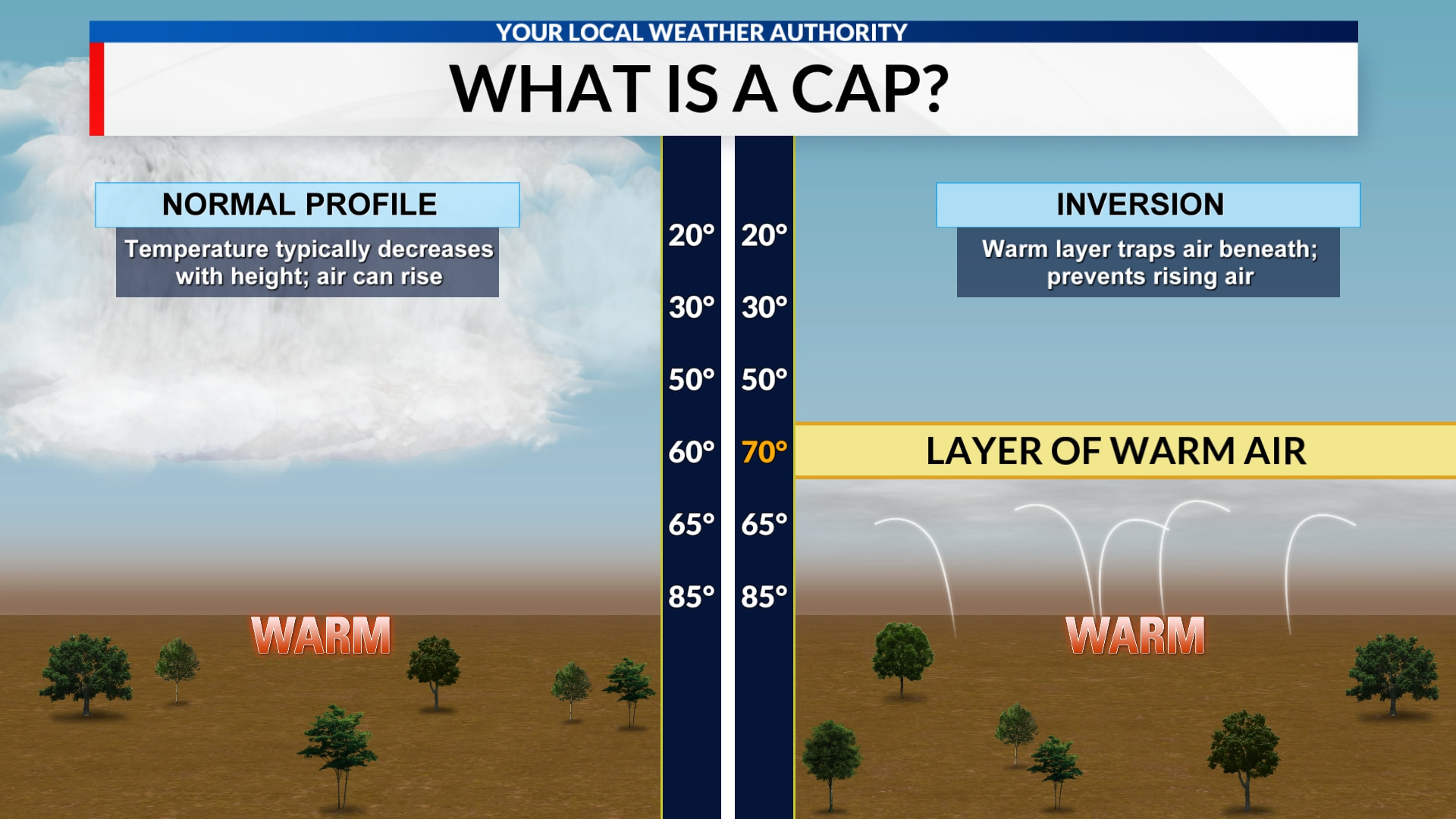
However, sometimes this cap can cause severe storms when the rising updrafts are strong enough to break through the cap. The updraft gains alot of extra strength and momentum before overcoming the cap inversion. And add some strong wind shear aloft and you have the prime ingredients for a supercell thunderstorm. 
It’s probably a little bit of both. There has always been small localized storms but modern improved radar technology makes them easier to spot. Also, strong to severe storms are typically more isolated in nature, and the effects of global warming are making such storms more likely and more severe overall.
And I agree, it does seem like in recent years we have had more isolated but insane thunderstorms at times with biblical amounts of lightning, torrential rains, wind, and large hail. I’m not saying global warming/climate change is 100% to blame, but I think it is definitely giving “some” of these storms an extra boost.
I’ve asked this on another post so sorry for doubling up. Is there any way to add a radar widget to the website similar to the one on the app? I know we could jsut click on over to NOAA but y’all are my one stop weather shop!
I’ve been intrigued by space weather lately and have seen some of the simulations on NOAA space weather Prediction site of solar flares and winds and the effects they have on our earth magnetic field. Is this a variable in our on meteorology earth weather forecasts models?
Given the “super nino” conditions predicted for the spring and summer months, what is your prediction on a flooding event similar to tax day over the next few months? Are these anomaly-type floods less likely in a wind shear environment or are they just as likely to happen since they are in fact, anomalies? Thanks!!
Not really a question, but more of a comment on the annual Colorado State University hurricane predictions. They remind me of the Farmer’s Almanac weather predictions - kinda cute, but it’s hard to put much stock in a forecast of anything, weather or otherwise, two to six months in advance. Matt said it perfectly on The Eyewall - “Which is why we so often preach that “it only takes one” and that seasonal forecasts are mostly amusing scientific pursuits and less actionable in any meaningful way.” I imagine they do it for publicity more than anything else.
You talk a lot about predicting temperature and rain, but less often about wind.
How hard is it to predict wind speed and direction at the surface? What about higher in the atmosphere, say 500 feet up? Is predicting wind easier or harder than predicting rain and temperature? Tell us about predicting wind for energy prediction markets (wind turbines).