The shift to Discourse gives the SCW team more tools to keep spam out and help steer conversations back to the weather—but we still can’t be everywhere at once.
Fortunately, we don’t have to be, because Discourse[1] also gives you a new tool: flagging.
Flag on the play
If you see a comment that’s spammy, or rude, or off-topic, or that otherwise doesn’t jive with the spirit of civil discussion we’re attempting to maintain, you should go ahead and flag that comment. That lets us (and the underlying Discourse commenting system) know that something may need attention.
To flag a comment, look beneath it for the three-dot “more” menu:

Click or tap on those dots and they’ll expand to show the flagging option (and the bookmark option, too!):

Click or tap the flag icon, and you’ll get the following popup so Discourse knows what to do with your flag:
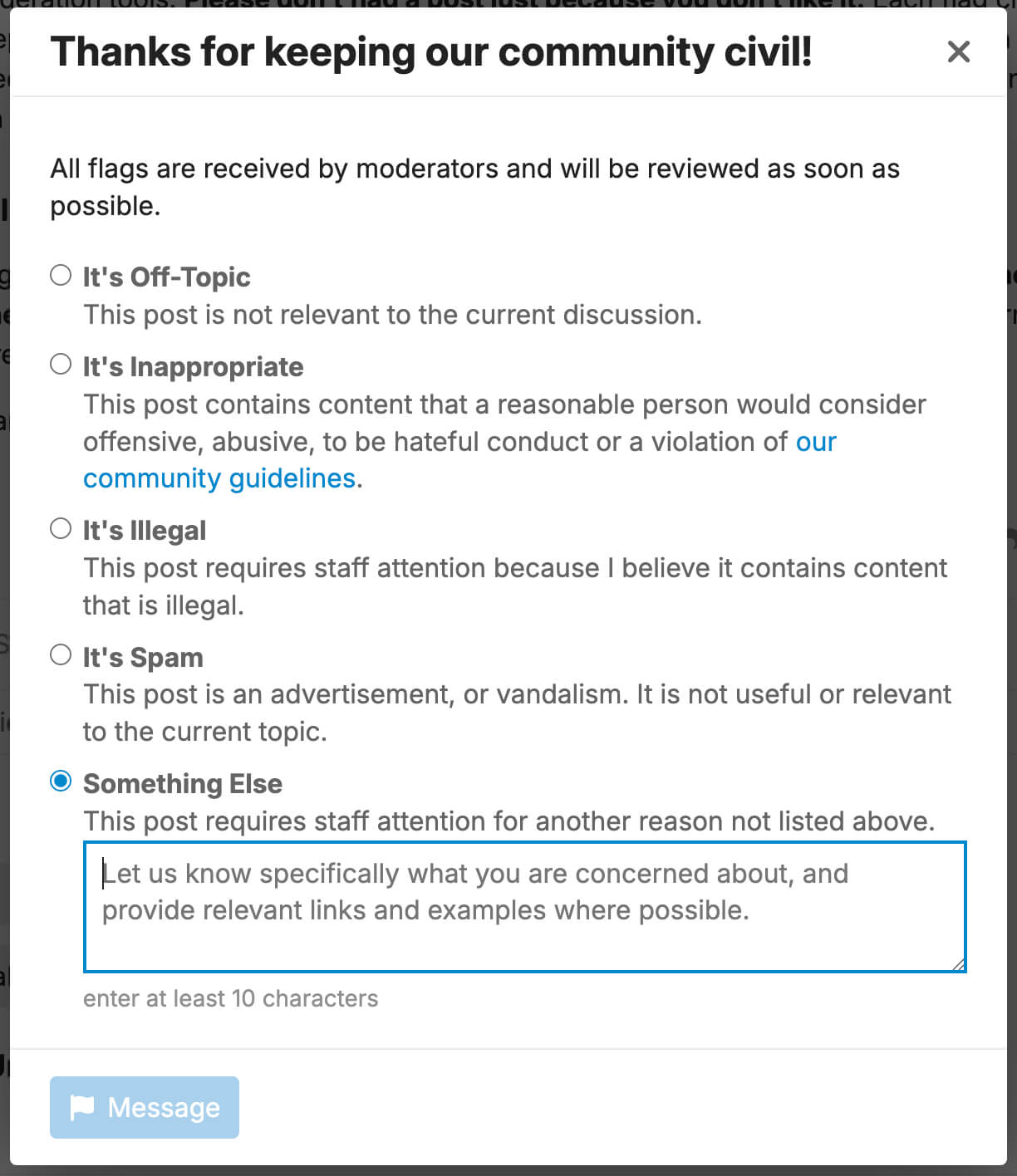
From here, pick the reason that matches the situation, or use the “Something Else” box if needed. (Pro tip: Using one of the predefined responses makes it a lot more likely the Discourse system will auto-apply some mitigation to the flagged post, especially with spam!)
Then click the “Message” button to send the flag. That’s it!
What happens then? When does the comment I flagged get moderated?
Flags send immediate notifications to the SCW staff, and we’ll see them as soon as we’re next online. More importantly, though, Discourse can also take automatic action on flags in certain situations.
If enough trusted users flag the same post, Discourse will hide that post temporarily until a staffer can take a look at it. This helps cool things down and nudge the discussion back on track, even when the admin team isn’t around.
What gets hidden and how and when?
Discourse takes a bunch of things into account when deciding whether or not to hide a flagged post automatically, including:
- Who flagged the post (flags by established accounts carry more “weight”)
- Who made the post (brand new accounts get very little benefit of the doubt)
- What kind of flag is being raised
So, for example, if a brand new account posts something questionable or spammy and an established reader with a solid posting history flags it, that single flag will usually be enough to temporarily hide the post for staff review. Conversely, posts from established users typically need a bunch of flags before Discourse hides them.
(For folks who want the gory details, this post on the Discourse developer forum dissects the flagging system’s functions, its weightings and rules, and the specific things it does and does not do.)
The flag button is not an “I disagree!” button!
We’re all grown-ups here, and we should settle disagreements with words, not with moderation tools. Please don’t flag a post just because you don’t like it. Each flag creates a report that a human SCW staffer has to read and review. We’re happy to do it when needed, but if you just don’t like someone’s take, you should jump into the discussion and win some hearts and minds by making a better argument.
Help keep the comments kind
Flagging isn’t about getting anyone “in trouble.” Rather, it’s about helping each other keep the discussion on-topic—especially during a storm, or a derecho, or whatever craziness the next Atlantic hurricane season throws at us.
Thanks for sticking around through this transition, and thanks for being such an awesome community!
Throughout this post, when I say “Discourse,” I’m referring specifically to our local copy of the forum software we’re running to host these discussions, not the company that created the software or any kind of third-party service. Flagging is all done entirely within the forum software! ↩︎